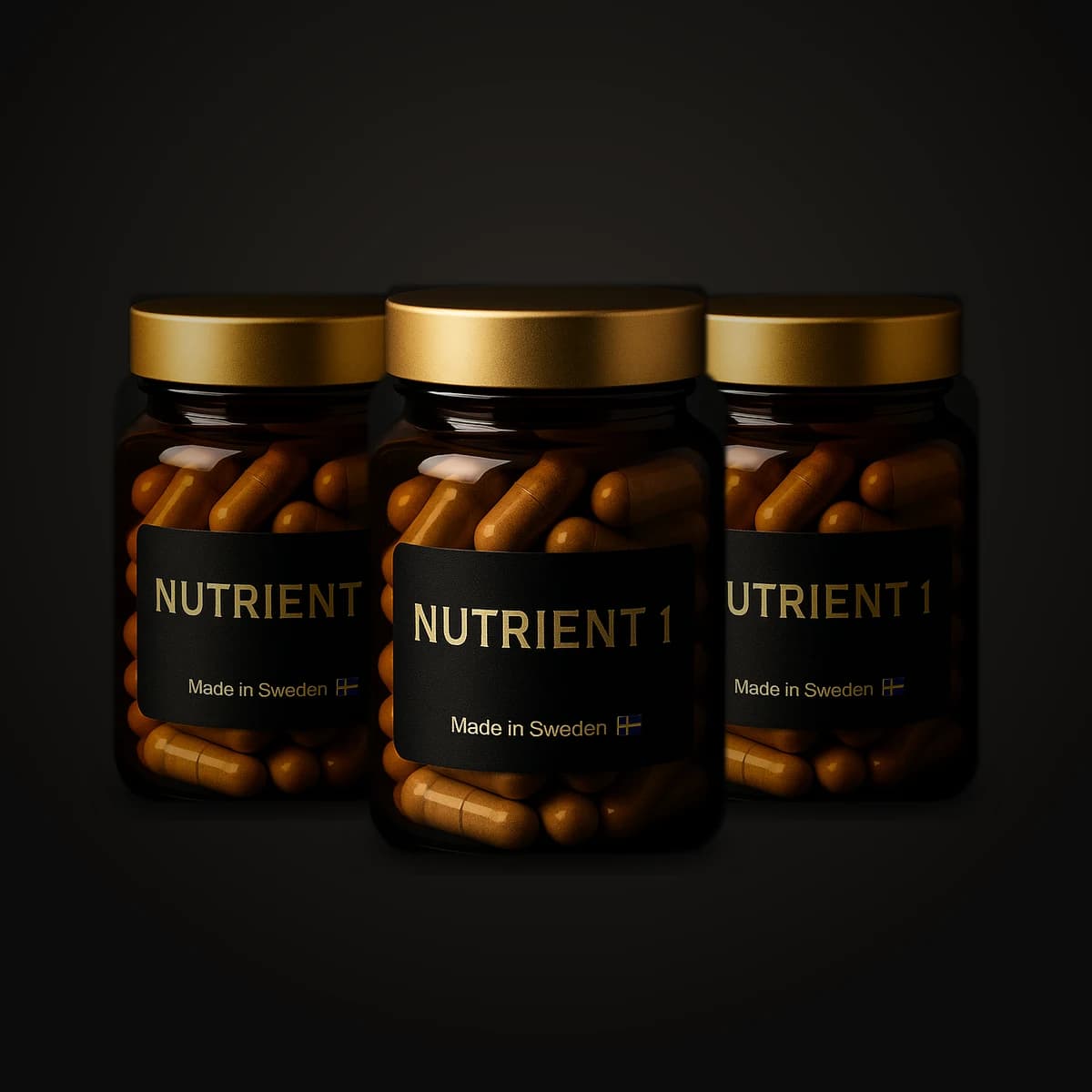
 Made & designed in Sweden.
Turn a supplement jar around and you’ll find a column of percentages — some small, some in the thousands. That column is labelled NRV or RI. It is one of the most useful parts of the label, and one of the most misunderstood.
NRV and RI are the same thing
NRV stands for Nutrient Reference Value. RI stands for Reference Intake. EU food law sets one reference value per vitamin and mineral for adults, and labels show how much of that value a serving provides. Older labels tend to say NRV, newer ones RI, but the numbers are the same.
The values are set out in Annex XIII of Regulation (EU) No 1169/2011. They exist so labels can be compared — not as personal recommendations.
The reference values
| Nutrient | Reference intake (adults) |
|---|---|
| Vitamin A | 800 µg |
| Vitamin D | 5 µg |
| Vitamin E | 12 mg |
| Vitamin K | 75 µg |
| Vitamin C | 80 mg |
| Thiamine (B1) | 1.1 mg |
| Riboflavin (B2) | 1.4 mg |
| Niacin (B3) | 16 mg |
| Pantothenic acid (B5) | 6 mg |
| Vitamin B6 | 1.4 mg |
| Biotin (B7) | 50 µg |
| Folic acid (B9) | 200 µg |
| Vitamin B12 | 2.5 µg |
| Calcium | 800 mg |
| Magnesium | 375 mg |
| Zinc | 10 mg |
| Copper | 1 mg |
| Manganese | 2 mg |
| Selenium | 55 µg |
| Iodine | 150 µg |
| Potassium | 2000 mg |
NRV is not your personal requirement
Your actual needs depend on age, sex, life stage and diet. National recommendations — in Sweden, the Nordic Nutrition Recommendations used by the Swedish Food Agency — often differ from the label values. Vitamin D is a good example: the label reference is 5 µg, while the Swedish Food Agency recommends 10 µg for most adults.
Why some percentages are over 100%
A value above 100% is not automatically too much. The reference intake says nothing about safety. Some nutrients are poorly absorbed, so supplements contain more — vitamin B12 is the clearest example, often listed at thousands of percent. Others, like vitamin D, are commonly given above the label reference because recommendations are higher than the reference value.
The number that is about safety: the upper limit
Safety is covered by a different value: the tolerable upper intake level (UL), set by EFSA. It is the highest daily intake from all sources that is unlikely to cause harm over a long period. For example, the UL for adults is 100 µg for vitamin D and 25 mg for zinc. For some nutrients, like vitamin B12, EFSA has not set a UL because no adverse effects have been identified.
This is why it matters to add up what you take. Two supplements that both contain zinc can together take you closer to the upper limit than either one alone.
Converting IU to µg
Some vitamins are still described in international units (IU), especially on products from outside the EU. EU labels use metric units. The conversions depend on the vitamin:
| Vitamin | Conversion |
|---|---|
| Vitamin D | 1 µg = 40 IU (so 25 µg = 1000 IU) |
| Vitamin A (as retinol) | 1 IU = 0.3 µg retinol |
| Vitamin E (natural, d-alpha-tocopherol) | 1 IU = 0.67 mg |
Reading a label in practice
- Check the serving size first. The percentages apply to one serving — for example, 3 capsules.
- Look at the form in brackets, such as “magnesium (citrate)”. The amount listed is the nutrient itself, not the whole compound.
- Add up overlapping nutrients if you take more than one supplement.
- Use the percentages to compare products, not as a personal target.
Sources
- Regulation (EU) No 1169/2011, Annex XIII — reference intakes
- EFSA — Overview on tolerable upper intake levels as derived by the SCF and EFSA
- Nordic Nutrition Recommendations 2023
- Commission Regulation (EU) No 432/2012 — permitted health claims
This article is general information about nutrition and is not medical advice. Food supplements should not be used as a substitute for a varied diet and a healthy lifestyle. If you have a medical condition, are pregnant or take medication, talk to your doctor before taking supplements.