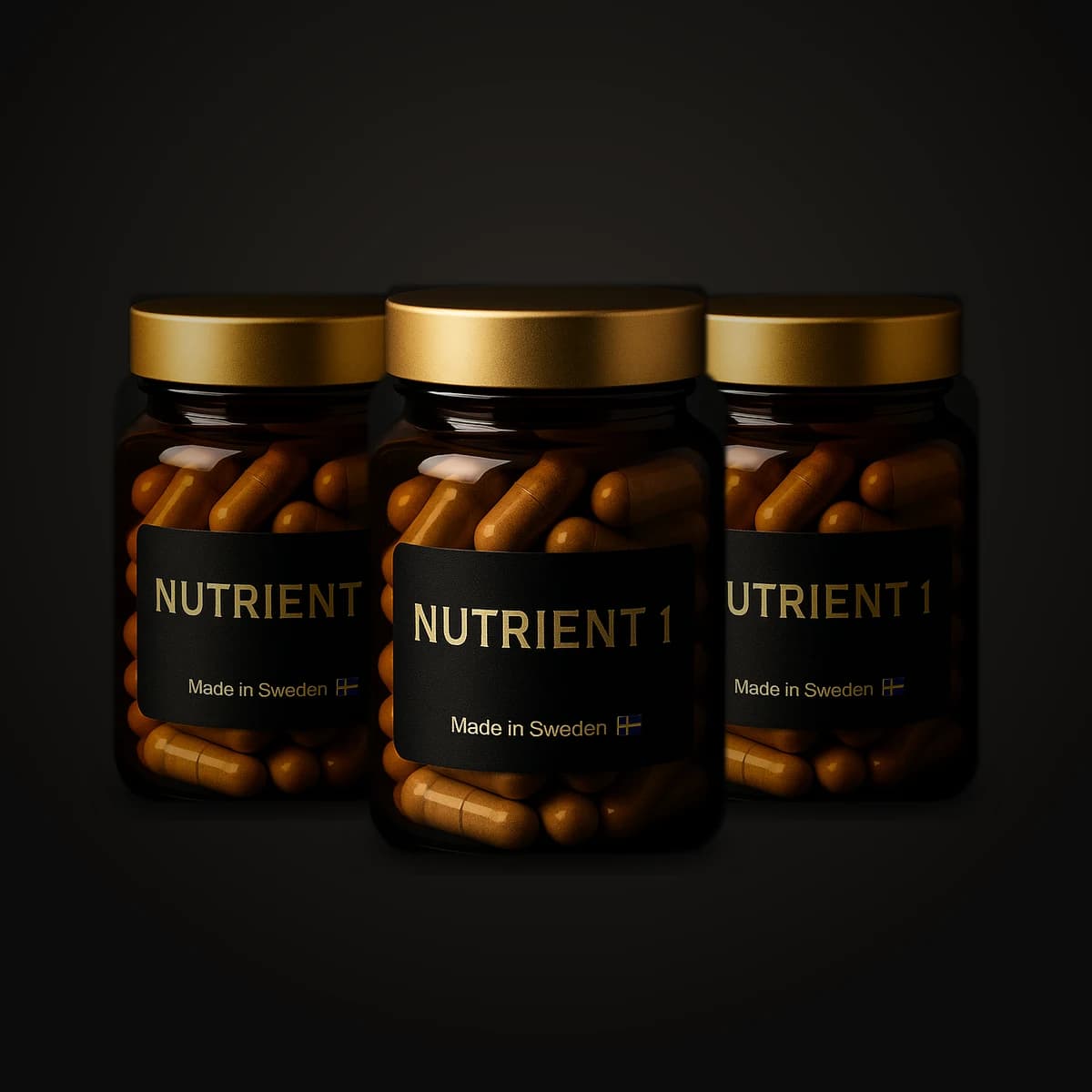
 Made & designed in Sweden.
Vitamin B12 is one vitamin with several names. On supplement labels you will mostly see two of them: cyanocobalamin and methylcobalamin. Both deliver vitamin B12 — but they are made differently, behave differently on the shelf, and are debated more than they probably need to be.
Vitamin B12 is a family of molecules
“Cobalamin” is the name for a group of molecules built around a cobalt atom. What differs between them is the small group attached to that cobalt. In the body, two forms do the actual work: methylcobalamin and adenosylcobalamin. Supplements mainly use cyanocobalamin, methylcobalamin, or hydroxocobalamin.
Cyanocobalamin: stable and well studied
Cyanocobalamin is the form most often used in supplements and fortified foods. It carries a cyanide group, which makes the molecule very stable and inexpensive to produce. The body removes this group and converts the cobalamin into its active forms.
The word “cyanide” sounds alarming, but the amount released from a supplement is tiny — far below anything considered harmful. Cyanocobalamin is also the form used in most of the research on B12 supplementation.
Methylcobalamin: one of the body’s own forms
Methylcobalamin is one of the two active forms of B12 and occurs naturally in food. It does not need the conversion step that cyanocobalamin needs. It is less stable to light than cyanocobalamin, which is something manufacturers have to account for.
Is one better than the other?
Both forms raise vitamin B12 levels in the body. Reviews comparing them describe differences in how they are absorbed, retained and excreted, but there isn’t strong evidence that one form gives healthy people a meaningfully different result than the other. Cyanocobalamin has the larger body of research; methylcobalamin has the advantage of already being an active form.
In other words, the choice is reasonable either way. What matters more is getting a reliable, regular intake.
Why B12 doses look so high
The reference intake for vitamin B12 on EU labels is just 2.5 µg per day. Yet supplements commonly contain 100 µg, 250 µg or more — thousands of percent of the reference intake. There’s a reason for that.
B12 is absorbed in two ways. The main route uses a protein called intrinsic factor, and it can only handle a small amount — about 1.5–2 µg — at a time. On top of that, around 1% of a larger dose is absorbed passively. Higher doses compensate for this limited uptake. EFSA has not set an upper limit for vitamin B12, as no adverse effects have been linked to high intakes.
Who needs to think about B12?
Vitamin B12 is found almost only in animal foods: meat, fish, eggs and dairy. People who eat a vegan diet need B12 from fortified foods or a supplement — the Swedish Food Agency recommends this. Absorption can also become less efficient with age, and some medications affect B12 uptake. If that applies to you, talk to your doctor.
What the EU allows anyone to say about vitamin B12
- Contributes to normal energy-yielding metabolism
- Contributes to normal functioning of the nervous system
- Contributes to normal homocysteine metabolism
- Contributes to normal psychological function
- Contributes to normal red blood cell formation
- Contributes to the normal function of the immune system
- Contributes to the reduction of tiredness and fatigue
- Has a role in the process of cell division
As with all EU health claims, these apply to vitamin B12 itself, regardless of form.
Sources
- Paul C, Brady DM. Comparative bioavailability and utilization of particular forms of B12 supplements with potential to mitigate B12-related genetic polymorphisms. Integr Med. 2017;16(1):42–49
- NIH Office of Dietary Supplements — Vitamin B12 fact sheet for health professionals
- EFSA NDA Panel. Scientific Opinion on Dietary Reference Values for cobalamin (vitamin B12). EFSA Journal 2015;13(7):4150
- Livsmedelsverket (Swedish Food Agency) — Vitamin B12 (in Swedish)
- European Commission — EU Register of nutrition and health claims
This article is general information about nutrition and is not medical advice. Food supplements should not be used as a substitute for a varied diet and a healthy lifestyle. If you have a medical condition, are pregnant or take medication, talk to your doctor before taking supplements.